
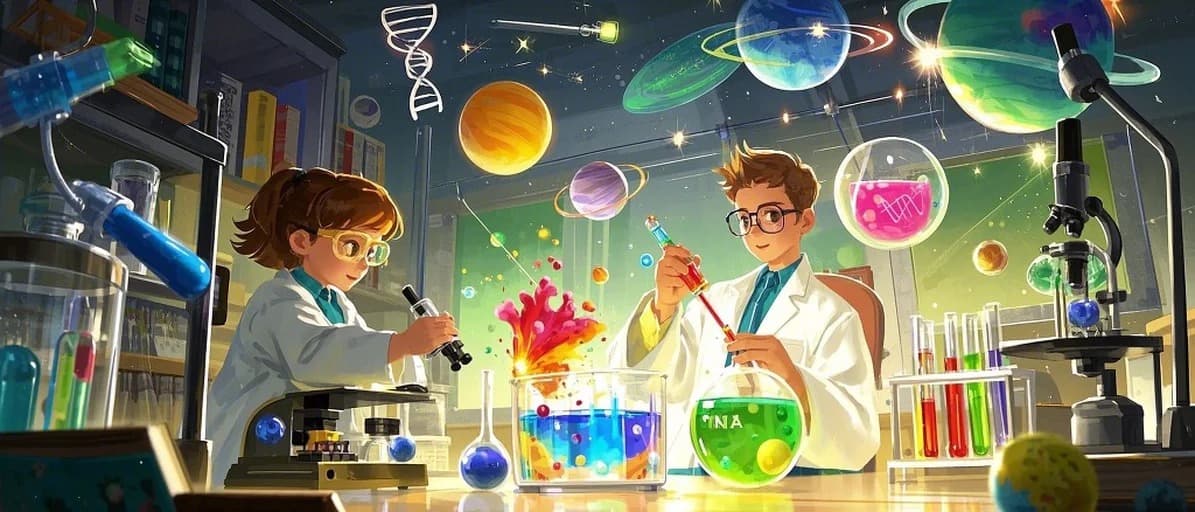
Science Stories for Kids
Explore the wonders of science through engaging stories that make complex concepts fun and accessible for young minds.
The Magic of Science Stories
Science stories transport children to exciting worlds where they can experience thrilling challenges, make important decisions, and discover the hero within themselves. These stories are more than just entertainment – they're powerful tools for development and learning.
STEM Foundation
Build strong science, technology, engineering, and math skills
Critical Thinking
Develop analytical and problem-solving abilities
Curiosity Nurturing
Foster a love for learning and discovery
Knowledge Retention
Learn through engaging stories and examples
Example Science Stories
See how AIStory creates engaging science stories that captivate children's imagination while teaching valuable lessons.
The Amazing Atom Adventure
Ages 7-10Join young scientist Alex as they discover the fascinating world of atoms and molecules through a magical microscope.
Story Excerpt:
“As Alex peered through the microscope, tiny particles danced before their eyes. Each one seemed to tell its own story, revealing the hidden world of science that surrounded them.”
The Solar System Explorer
Ages 5-8Follow Sarah on an educational journey through our solar system, learning about planets, stars, and the vastness of space.
Story Excerpt:
“The rocket ship zoomed past colorful planets, each one unique in its own way. Sarah couldn't believe she was actually exploring the solar system!”
Key Elements of Great Science Stories
The best science stories combine these essential ingredients to create memorable experiences.
Scientific Concepts
Clear explanations of scientific principles
Problem-Solving
Critical thinking and hypothesis testing
Hands-on Discovery
Interactive experiments and observations
Real-World Applications
Connecting science to everyday life
Age-Appropriate Science Ideas
Science stories can be tailored to different age groups, with appropriate complexity and themes.
Ages 4-6
Simple science concepts and basic experiments
Story Ideas:
Ages 7-9
More complex scientific concepts and experiments
Story Ideas:
Ages 10-12
Advanced scientific principles and real-world applications
Story Ideas:
Science Story Prompts
Use these prompts as starting points for your own unique science stories.
Scientific Discovery Prompts
- 1
What would you discover in a hidden laboratory?
- 2
How would you solve a mysterious scientific phenomenon?
- 3
What experiments would you conduct in a magical science lab?
- 4
How can science help solve everyday problems?
Science Story Ideas
- 1
A day in the life of a young scientist
- 2
The invention that changed the world
- 3
A journey through the human body
- 4
The mystery of the disappearing stars
Ready to Create Your Science Story?
Start your journey today and create personalized science stories that will inspire and delight.
Read a free example story
Science stories work best when a character asks “why?” and then finds out by watching, testing and trying again, just like a real scientist. Read this free example science story about rainbows with your child, then try the simple experiment below.
Theo Catches a Rainbow
Ages 5-9 · 3 min read
After the rain stopped, Theo pressed his nose to the window. A rainbow stretched across the sky, from the park all the way to the bakery.
“Where do rainbows come from?” he asked his big sister, Ana.
“Sunlight,” Ana said. “And water.”
Theo frowned. “Sunlight is yellow. Water is clear. Where do all the colors come from?”
Ana grinned. “Let’s find out.” She filled a clear glass with water and set it on the sunny windowsill. Under the glass, she laid a sheet of white paper.
They waited. Theo tapped his foot. Then, slowly, a tiny stripe of color appeared on the paper: red, orange, yellow, green, blue and violet, lined up like crayons in a box.
“A rainbow in our kitchen!” Theo shouted.
“Sunlight looks white or yellow,” Ana explained, “but it is really made of all the colors mixed together. When light passes through water, it bends. Each color bends a little differently, so the colors spread out.”
“So raindrops in the sky are like millions of tiny glasses of water?” Theo asked.
“Exactly,” said Ana. “That’s why you see rainbows when the Sun comes out right after the rain.”
Theo moved the glass a little to the left. The rainbow moved too. He tilted the paper, and the colors stretched longer. He was not just looking at a rainbow anymore. He was doing an experiment.
That evening he wrote in his notebook: “Question: Where do rainbows come from? Answer: Sunlight bends in water and splits into colors. Next question: Can I make a rainbow with a garden hose?”
Try it at home: make a rainbow
- Fill a clear glass with water and place it in bright sunlight, on a windowsill or a table.
- Put a sheet of white paper on the floor or table where the light shines through the glass.
- Move the glass or the paper until a band of colors appears. Count the colors together.
- On a sunny day, stand with your back to the Sun and spray a fine mist from a hose. Look for a rainbow in the spray.
Questions to ask after reading
- What two things do you need to make a rainbow?
- Why do the colors spread out when light goes through water?
- What did Theo do that made him a scientist?
- What question would you like to test with an experiment?